
You can travel anywhere with a smile and a piece of string.
--A.C. Haddon

I "collected" this string figure of a turtle from Chizuko Hiyo in
the Computer Lab on September 19, 2002 at College of the Siskiyous in Weed,
California. Chizuko came to America from Japan several years ago. She is married
to Cody and lives in California for most of the year, spending part of the year
in Japan with her parents. Chizuko was exceedingly patient with me, having showed
me how to make the turtle about twenty times before I got it.
People have been passing along and collecting string figures for generations.
In the late 1800s, two anthropologists, Alfred C. Haddon and Dr. W.H.R. Rivers,
developed a special vocabulary to record the construction of string figures
(Gryski 10; Abraham 10). I will use their terminology, as presented by Gryski
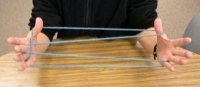
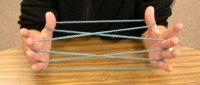
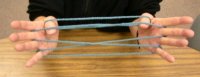
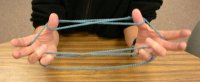
(10-17), to describe how Chizuko made the string turtle with a two meter string
formed into a loop.
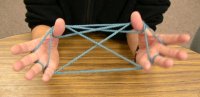
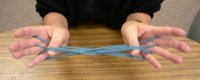
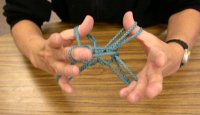
Note: Directions are written for the maker, but the pictures
were taken looking at the maker
(rather than the maker looking at the string).
|
 |
|
 |
|
 |
|
 |
|
 |
|
 |
|
 |
|
 |
|
 |
|
 |
|
 |
|
 |
|
 |
|
 |
|
 |
|
 |
|
 |
|
 |
|
 |
|
 |
|
 |
The turtle, or kame in Japanese, is a common motif in Japanese folklore,
often indicating longevity. It appears in several folktales, there are several
origami models of the turtle, "tortoise and cranes" are a type
of garden, and it is part of a famous proverb: A crane lives one thousand
years and a turtle lives ten thousand years.
The number ten thousand is also a significant number in East Asia; "ten thousand" is used like we use the word "million;" to mean "a lot." The turtle, as the proverb segment indicates, is frequently used to mean longevity and can be seen on cards or banners wishing one a long life.

Kanji meaning "ten thousand years" or "eternity."
Regardless of the original intent or meaning of the kame string figure,
to me, and I think to Chizuko, the function was mainly to have fun. String figures
are also made to delight and impress each other. String figures around the world
were often used as part of storytelling (Gryski 6), and it may be that the turtle
or other string figures were used in Japan this way as well.
The technology needed for playing string games or creating string figures is readily available, since most cultures around the world utilize string. Because string can be made from many plant and animal products, and is usually inexpensive and on hand, this game is readily accessible. Making string figures helps a person improve their memory and dexterity, and allows an outlet for creativity. The process of collecting this turtle string figure from Chizuko has renewed my interest in string figures.
I have noticed that animal figures are very prominent in Japanese lore. In particular, one of my favorite stories is Urashima Taro, which features a young fisherman and a turtle. The turtle is being tortured by a group of boys and a young man from the nearby village saves the turtle. As the young man carries the turtle back to the ocean it comforts it by saying, "Remember, cranes live a thousand years, but a turtle lives ten thousand, so you still have a long life ahead of you" (Ozaki 28).

Tortoise and Crane garden at Chion-in in Kyoto, Japan
The religions of Japan are also conducive to the development of animal stories.
The indigenous religion, Shinto, is animistic in nature and values animals.
Buddhism was introduced in the 6th century and prohibits the harming of animals.
Confucianism, too, may have had some influence in the turtle being a popular
figure, as Confucianism highly values the elderly and the turtle represents
longevity. In my eyes, Japanese art and architecture is very beautiful, and
the turtle shape is a part of that beauty. Imagine the shape of a tortoise shell.
It is a hemispherical dome, a very pleasing shape resembling, as it does, the
earth, the sun, or the moon. I saw a few tortoise and crane gardens in Japan
this summer. I see the rocks as cranes, and the dome-shaped shrubs are the tortoise
part. As I mentioned earlier, the symbolism of long life is held in the turtle.
The Japanese as a group revere the older generation, and so I think that makes
the turtle a very popular motif in folk art.
Abraham, A. Johnston. String Figures. Algonac, Michigan: Reference Publications, Inc., 1988.
Breen, Jim. "Jim Breen's WWWJDIC Server." <http://www.csse.monash.edu.au/cgi-bin/cgiwrap/jwb/wwwjdic?1C>.
Brunvand, Jan. The Study of American Folklore. New York: Norton, 1995.
Hiyo, Chizuko. Personal Communication. 19 Sept. 2002.
Freeman, Linda. Pictures of Chizuko making string turtle (November 2002) and Kyoto garden scene (July 2002).
Gryski, Camilla. Cat's Cradle, Owl's Eyes: A Book of String Games. New York: Beech Tree Books, 1983.
Ozaki, Yei Theodora. The Japanese Fairy Book. Tokyo: Tuttle Publishing, 1970.
Chizuko-san, domo arigato gozaimashita.