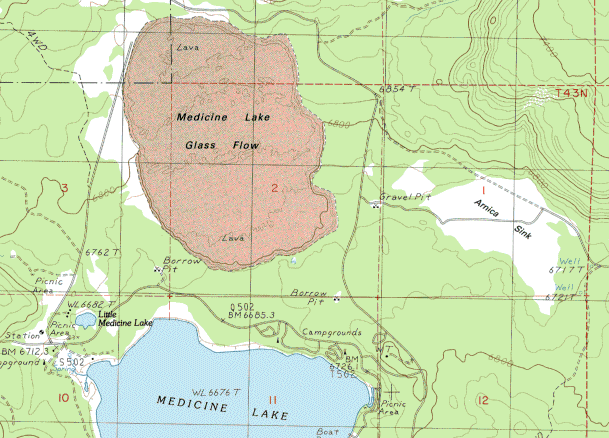
Medicine Lake Glass Flow, Medicine Lake, and Medicine Mountain
September 12, 1998
Medicine Lake Glass Flow is just north of Medicine Lake (see map). Both of these features lie in the caldera, which is not as spectacular as nearby Crater Lake as the caldera has been filled in by deposits from the several rim volcanoes (MacDonald, 1966). The Medicine Lake Glass Flow is a Late Holocene dacite flow which covers an area of 2.5 km2 (Donnelly-Nolan, 1990). It is interesting to note the distribution pattern of the different types of lava in the region. Basalt mainly occurs below 6,000 feet while dacite and rhyolite are found above 6,000 feet. There are various theories to account for this occurrence (Anderson, 1941; Donnelly-Nolan, 1988) which are discussed below.
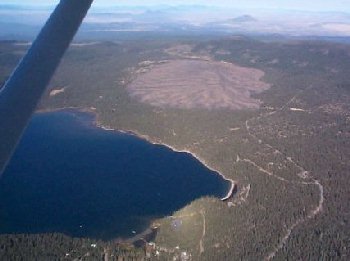
Medicine Lake and Medicine Flow
October 17, 1998
There are various mechanisms which can result in a change from basalt to andesite to dacite to rhyolite. One process is known as crystal fractionation. If basalt is in a chamber, the basalt on the outside of the mass will cool more quickly than the interior. Where it cools, crystals of olivine and plagioclase will develop. As these minerals separate out, it leaves the magma depleted in calcium and magnesium and richer in silica. This results in a magma which would form andesite, or even dacite or rhyolite if enough crystals formed earlier on.
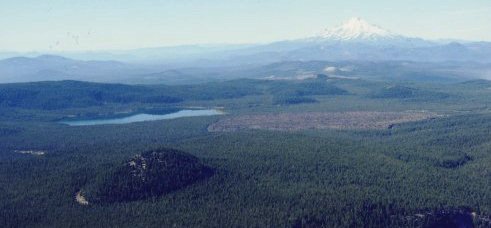
Medicine Lake and Medicine Flow with Mount Shasta in the distance
Photo by Bill Hirt, October 17, 1998
Another process is called assimilation. This is when older, in situ rocks are assimilated into the magma when the magma comes into contact with the rocks. Depending on the composition of the original bedrock, this can add silica into the magma which will then result in a basaltic andesite or andesite.
A third process is called magma mixing. This occurs when two different magmas come into contact with each other and mix together, resulting in a hybrid composition such as dacite.
While it appears that crystal fractionation did occur on Glass Mountain, the actual situation is more complex with assimilation simultaneously occurring (Grove, et. al., 1997). The Burnt Lava Flow appears to have been produced by all three processes (Donnelly-Nolan, et. al., 1990). Likewise, the Giant Crater Lava Flow was produced by all three processes (Donnelly-Nolan, et. al., 1991). All of the dacites produced during the last 11,000 years have been produced by mixing (Hirt, class notes 1998), therefore the Medicine Lake Flow is at least partially produced by this process.
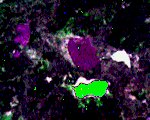
Bands 1, 3, 2
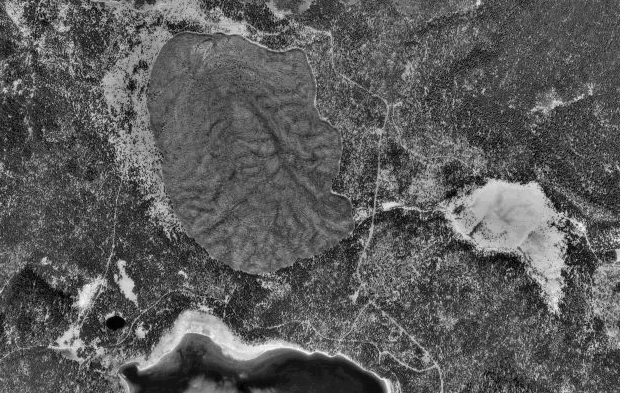 If
one (such as myself) was to examine the composite images without a clear understanding
of the geology, it would be easy to come to the conclusion that the Medicine
Lake Glass Flow is compositionally zoned. However, this is not the case (Donnelly-Nolan,
personal communication, 1998), and so I have selected the composite image above
as the "best" image which portrays the chemical composition of the
Medicine dacite flow, shown as dark purple north of Medicine Lake, which, in
turn, is shown as lime green. The white area in the above image, to the east
of the dacite flow, is called Arnica Sink. This is Quaternary alluvium, according
to the Geologic Map of California - Alturas Sheet (1968).
If
one (such as myself) was to examine the composite images without a clear understanding
of the geology, it would be easy to come to the conclusion that the Medicine
Lake Glass Flow is compositionally zoned. However, this is not the case (Donnelly-Nolan,
personal communication, 1998), and so I have selected the composite image above
as the "best" image which portrays the chemical composition of the
Medicine dacite flow, shown as dark purple north of Medicine Lake, which, in
turn, is shown as lime green. The white area in the above image, to the east
of the dacite flow, is called Arnica Sink. This is Quaternary alluvium, according
to the Geologic Map of California - Alturas Sheet (1968).
Return to MSS Composite Images

This page prepared Fall 1998 for Earth
Science 739 Research Problems
taught by James S. Aber at Emporia State
University
©1998 Linda Freeman